Agentic Payment OS
Protocol for the emerging Agentic Economy

Global Infrastructure Connectivity Engine

Identity, Trust, and
the Personalization Engine
Access a variety of AI Agents for your everyday needs
Agent Creation
Easy AI Agent Creation Tools
APOS
Agentic Payment Operating System
DID
Decentralized Identity System with complete privacy and security
Decentralized Identity and Reputation System for AI Agents

The Agentic Framework & Autonomy Engine
Universal Settlement & Orchestration Engine
Global Infrastructure Connectivity Engine
Identity, Trust, and
the Personalization Engine
DID
Decentralized Identity System with complete privacy and security
Decentralized Identity and Reputation System for AI Agents
APOS
Agentic Payment Operating System
Access a variety of AI Agents for your everyday needs
Agent Creation
Easy AI Agent Creation Tools
The Agentic Framework & Autonomy Engine
Universal Settlement & Orchestration Engine
Agentic Payment Operating System (APOS)
The AIOT Agentic Payment OS functions as a dedicated connectivity protocol designed to bridge the gap between legacy financial infrastructure and the demands of the emerging Agentic Economy.
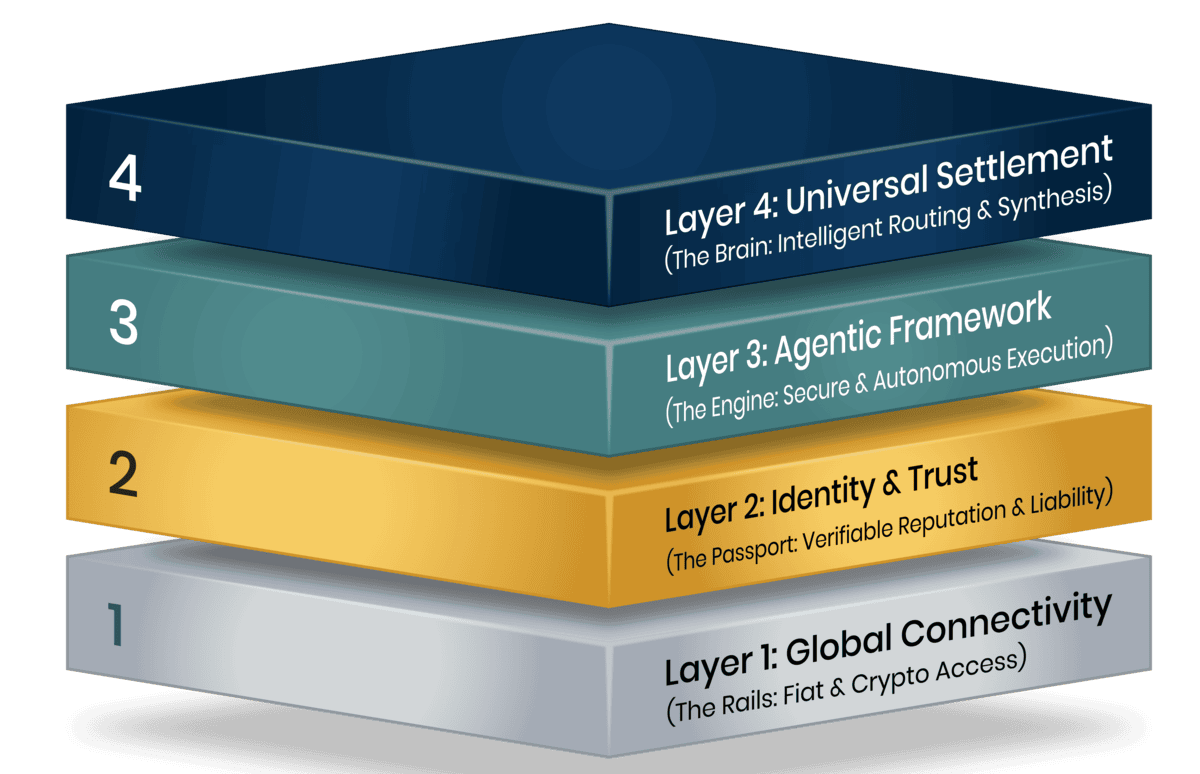
AIOT employs a “Direct Facilitation” strategy through a four-layer stack:

APOS Integrations
Explore some of the essential integrations that power AIOT's Agentic Payments Operating System
x402
Enabling payment for resources via API without registration, emails, OAuth, or complex signatures using cryptocurrency
ACP Protocol
Enabling dialogue between buyers, their AI agents, and businesses to conduct purchases
ERC4337
Enabling account abstraction for improved user experience, account recovery, gasless transactions, and programmable permissions
ERC8004
On-chain audit trail to enable a verifiable reputation system and registry for AI Agents
A2A Protocol
Enabling seamless communication and collaboration between AI agents
Fiat Payment Rails
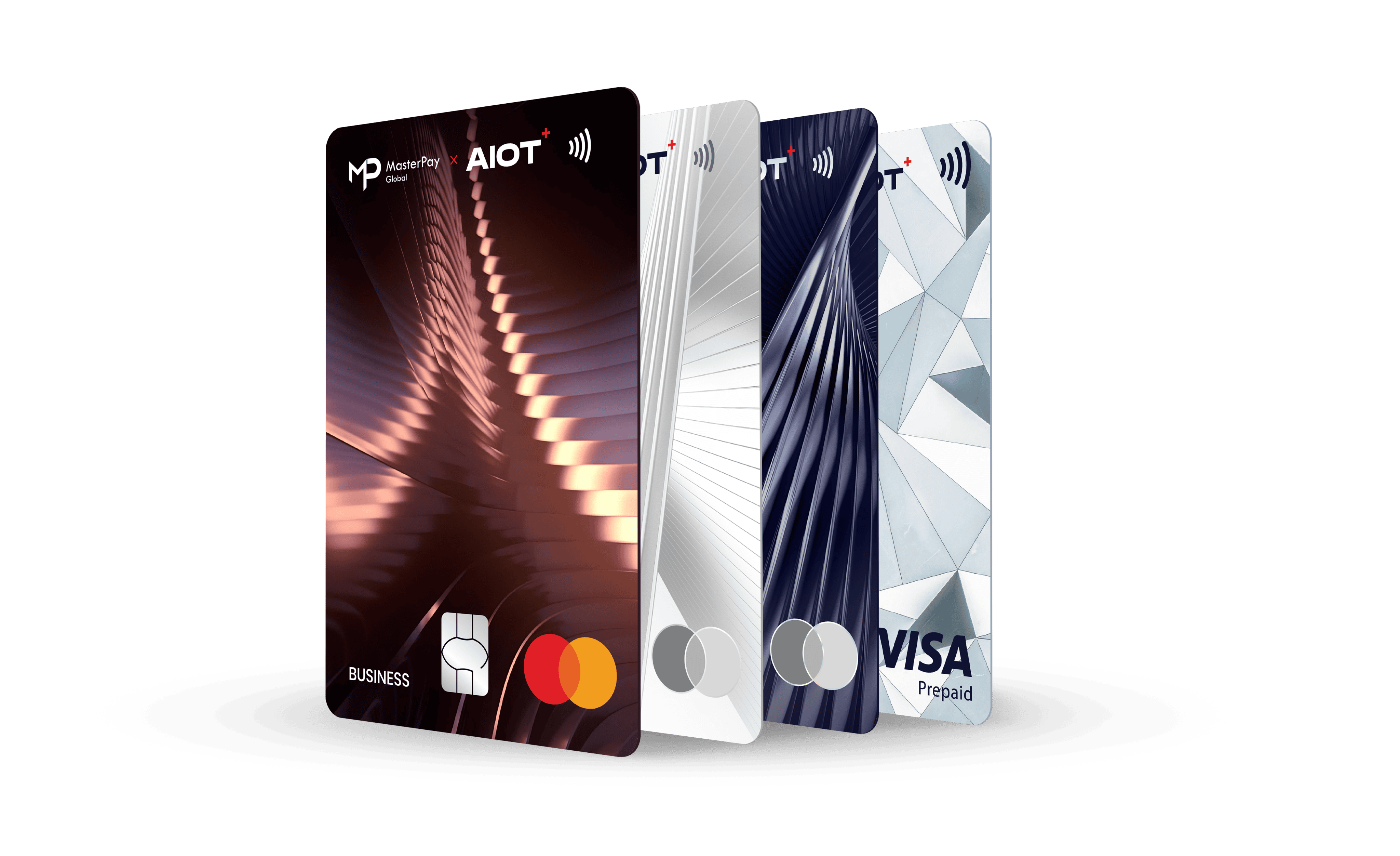
Seamless plugin with AIOT VISA Card to enable fiat settlement
AIOT Web3 Card
Sign up for AIOT physical or virtual card to easily spend your crypto and AIOT at over 100 million merchants throughout the world while earning rewards for spending.
Your AI journey in 3 steps
A simplified user experience to deliver instant improvements to your quality of life
Create an account
Sign up to access our website and app
Create your DID
Your DID (fully under your control) will serve as the key for portable personalization and unified context
Access AI Agents
Connect your DID to AI Agents to help you with your everyday tasks
Case Studies
Here are some examples of how AI Agents can help you save time and money
Case Study 1
Algorithmic Expense Optimization
Scenario :
- User pays $15/month for a streaming service they rarely use, and $50/month for a gym membership they visit daily.
Agent Action :
- The Agent accesses the DID-anchored Personalization Graph and identifies the inefficiency. It negotiates via A2A protocols to cancel the streaming service. Simultaneously, it finds a corporate discount for the gym via a partner API.
Execution :
- The agent uses the AIOT Virtual Card to pay the new, lower gym rate and leverages ERC-4337 batching to revoke the streaming subscription authorization.
Result :
Verified savings with zero user effort, optimized purely by code.
Case Study 2
Seamless Recurring Billing Automation
Scenario :
- Managing bill due dates creates cognitive load. A missed payment results in fees.
Agent Action :
- The Agent maps all utility and rent payments. It sets up Session Key Mandates for each vendor (e.g., "Landlord: Max $2000, Monthly").
Execution :
- On the due date, the Orchestration Layer checks the user's liquidity. If the user holds mostly ETH and the bill is in USD, the X402A layer auto-converts the necessary amount and routes the payment via the ACH rail (Layer 1).
Result :
Automated financial hygiene and elimination of late fees.
Case Study 3
Intelligent On-Demand Procurement
Scenario :
- User tells their device: "Order me a double cheeseburger with bacon, but make sure it's from a place with good hygiene ratings."
Agent Action :
- The Agent calculates the Net Present Value (NPV) of using points vs. cash for the specific flight. It identifies that using "Airline A Points" yields a value of 3 cents/point, whereas "Card B Points" yields only 1 cent/point.
Execution :
- The Agent executes the booking using the optimal mix of points and cash, routing the cash portion via the AIOT card to earn further rewards.
Result :
Frictionless procurement where the financial authorization is tightly coupled to the specific intent.
Case Study 4
Advanced Anomalous Consumption Detection (ACD)
Scenario :
- A traditional bank blocks a card because the user buys coffee in London and lunch in Paris on the same day.
Agent Action :
- A traditional bank blocks a card because the user buys coffee in London and lunch in Paris on the same day.
Execution :
- The transaction is validated instantly because the context explains the anomaly.
Result :
Non-disruptive security that adapts to the user's lifestyle rather than forcing the user to fit the bank's rigid models.
Case Study 5
Maximal Reward Application
Scenario :
- A user has points across three different airlines and two credit cards. They want to book a flight.
Agent Action :
- The Agent calculates the Net Present Value (NPV) of using points vs. cash for the specific flight. It identifies that using "Airline A Points" yields a value of 3 cents/point, whereas "Card B Points" yields only 1 cent/point.
Execution :
- The Agent executes the booking using the optimal mix of points and cash, routing the cash portion via the AIOT card to earn further rewards.
Result :
Maximize value capture on every transaction through computational arbitrage.
Case Study 1
Algorithmic Expense Optimization
Scenario :
- User pays $15/month for a streaming service they rarely use, and $50/month for a gym membership they visit daily.
Agent Action :
- The Agent accesses the DID-anchored Personalization Graph and identifies the inefficiency. It negotiates via A2A protocols to cancel the streaming service. Simultaneously, it finds a corporate discount for the gym via a partner API.
Execution :
- The agent uses the AIOT Virtual Card to pay the new, lower gym rate and leverages ERC-4337 batching to revoke the streaming subscription authorization.
Result :
Verified savings with zero user effort, optimized purely by code.
Case Study 2
Seamless Recurring Billing Automation
Scenario :
- Managing bill due dates creates cognitive load. A missed payment results in fees.
Agent Action :
- The Agent maps all utility and rent payments. It sets up Session Key Mandates for each vendor (e.g., "Landlord: Max $2000, Monthly").
Execution :
- On the due date, the Orchestration Layer checks the user's liquidity. If the user holds mostly ETH and the bill is in USD, the X402A layer auto-converts the necessary amount and routes the payment via the ACH rail (Layer 1).
Result :
Automated financial hygiene and elimination of late fees.
Case Study 3
Intelligent On-Demand Procurement
Scenario :
- User tells their device: "Order me a double cheeseburger with bacon, but make sure it's from a place with good hygiene ratings."
Agent Action :
- The Agent calculates the Net Present Value (NPV) of using points vs. cash for the specific flight. It identifies that using "Airline A Points" yields a value of 3 cents/point, whereas "Card B Points" yields only 1 cent/point.
Execution :
- The Agent executes the booking using the optimal mix of points and cash, routing the cash portion via the AIOT card to earn further rewards.
Result :
Frictionless procurement where the financial authorization is tightly coupled to the specific intent.
Case Study 4
Advanced Anomalous Consumption Detection (ACD)
Scenario :
- A traditional bank blocks a card because the user buys coffee in London and lunch in Paris on the same day.
Agent Action :
- A traditional bank blocks a card because the user buys coffee in London and lunch in Paris on the same day.
Execution :
- The transaction is validated instantly because the context explains the anomaly.
Result :
Non-disruptive security that adapts to the user's lifestyle rather than forcing the user to fit the bank's rigid models.
Case Study 5
Maximal Reward Application
Scenario :
- A user has points across three different airlines and two credit cards. They want to book a flight.
Agent Action :
- The Agent calculates the Net Present Value (NPV) of using points vs. cash for the specific flight. It identifies that using "Airline A Points" yields a value of 3 cents/point, whereas "Card B Points" yields only 1 cent/point.
Execution :
- The Agent executes the booking using the optimal mix of points and cash, routing the cash portion via the AIOT card to earn further rewards.
Result :
Maximize value capture on every transaction through computational arbitrage.
Case Study 1
Algorithmic Expense Optimization
Scenario :
- User pays $15/month for a streaming service they rarely use, and $50/month for a gym membership they visit daily.
Agent Action :
- The Agent accesses the DID-anchored Personalization Graph and identifies the inefficiency. It negotiates via A2A protocols to cancel the streaming service. Simultaneously, it finds a corporate discount for the gym via a partner API.
Execution :
- The agent uses the AIOT Virtual Card to pay the new, lower gym rate and leverages ERC-4337 batching to revoke the streaming subscription authorization.
Result :
Verified savings with zero user effort, optimized purely by code.
Case Study 2
Seamless Recurring Billing Automation
Scenario :
- Managing bill due dates creates cognitive load. A missed payment results in fees.
Agent Action :
- The Agent maps all utility and rent payments. It sets up Session Key Mandates for each vendor (e.g., "Landlord: Max $2000, Monthly").
Execution :
- On the due date, the Orchestration Layer checks the user's liquidity. If the user holds mostly ETH and the bill is in USD, the X402A layer auto-converts the necessary amount and routes the payment via the ACH rail (Layer 1).
Result :
Automated financial hygiene and elimination of late fees.
Case Study 3
Intelligent On-Demand Procurement
Scenario :
- User tells their device: "Order me a double cheeseburger with bacon, but make sure it's from a place with good hygiene ratings."
Agent Action :
- The Agent calculates the Net Present Value (NPV) of using points vs. cash for the specific flight. It identifies that using "Airline A Points" yields a value of 3 cents/point, whereas "Card B Points" yields only 1 cent/point.
Execution :
- The Agent executes the booking using the optimal mix of points and cash, routing the cash portion via the AIOT card to earn further rewards.
Result :
Frictionless procurement where the financial authorization is tightly coupled to the specific intent.
Case Study 4
Advanced Anomalous Consumption Detection (ACD)
Scenario :
- A traditional bank blocks a card because the user buys coffee in London and lunch in Paris on the same day.
Agent Action :
- A traditional bank blocks a card because the user buys coffee in London and lunch in Paris on the same day.
Execution :
- The transaction is validated instantly because the context explains the anomaly.
Result :
Non-disruptive security that adapts to the user's lifestyle rather than forcing the user to fit the bank's rigid models.
Case Study 5
Maximal Reward Application
Scenario :
- A user has points across three different airlines and two credit cards. They want to book a flight.
Agent Action :
- The Agent calculates the Net Present Value (NPV) of using points vs. cash for the specific flight. It identifies that using "Airline A Points" yields a value of 3 cents/point, whereas "Card B Points" yields only 1 cent/point.
Execution :
- The Agent executes the booking using the optimal mix of points and cash, routing the cash portion via the AIOT card to earn further rewards.
Result :
Maximize value capture on every transaction through computational arbitrage.
Frequently Asked Questions
Everything You Need to Know Before You Start.
AIOT DID (Decentralized Identifier) is a unique, self-sovereign digital identity that gives you complete control over your personal data and interactions with AI agents. It serves as the foundation for secure, private transactions in the agentic economy.
An AID (Agent ID) is a decentralized identity assigned to AI agents within the AIOT ecosystem. It enables verification, trust scoring, and accountability for autonomous agents performing tasks on your behalf.
AIOT implements a comprehensive trust framework including on-chain reputation systems (ERC-8004), verifiable credentials, and transparent audit trails. Every agent action is recorded and can be verified, ensuring accountability and trustworthiness.
A2A (Agent-to-Agent) is a communication protocol that enables AI agents to interact, negotiate, and collaborate with each other seamlessly. This allows for complex multi-agent workflows and efficient task completion.
x402 is a protocol for API-based cryptocurrency payments. Stripe ACP and Virtuals ACP are Agent Commerce Protocols that enable AI agents to conduct purchases and handle transactions on behalf of users through established payment infrastructure.